TOLMAN, Deryk. et al. Relaxed selection diminishes social memory and expression of host defenses against cuckoos. Evolution, 2026
Brood parasites, such as common cuckoos (Cuculus canorus), lay mimetic eggs in their hosts’ nests: a strategy to avoid the costs of parental care. To avoid being exploited, host species have adapted and become better at recognising the impostor’s egg. Moreover, while hosts have evolved to mob intruders away from their nests, cuckoos have developed features that resembles those of a hawk (predators of adult birds), such as barred chest and yellow eyes, which help them deter the mobbing attempts. This evolutionary struggle, or “arms race”, arises when the adaptation of a species acts as selection pressure on another species, which then develops counter-adaptations, and so on. But what happens to these mechanisms when parasitism risk decreases and selection pressure is relaxed?
Reed warblers (Acrocephalus scirpaceus) are a favorite host of cuckoos across Europe, and have developed all sorts of mechanisms to defend themselves from parasitism. While cuckoos have adapted, with better resembling features of a hawk and almost perfectly mimetic eggs of those of the hosts, reed warblers have also become better and better at recognising the copy from reality.
Recently this species has undergone a geographic shift, expanding their range north to Finland (for more information about this, read Nora Bergman’s interview, “Where do Finnish Reed warblers come from?”), escaping cuckoos. Since the first historical record of their presence in Finland is from around ~100 years ago, the natural question is: what happened to them? Could they lose the defence mechanisms against parasitism – or are they retained and simply choosing not to use them?
To reply to these questions, Deryk Tolman spent four years studying a local population of reed warblers, using 3D printed cuckoos and recordings of warblers’ mobbing calls. His work was divided in three steps, in which he collected different information about this host’s responses to parasitism risks.
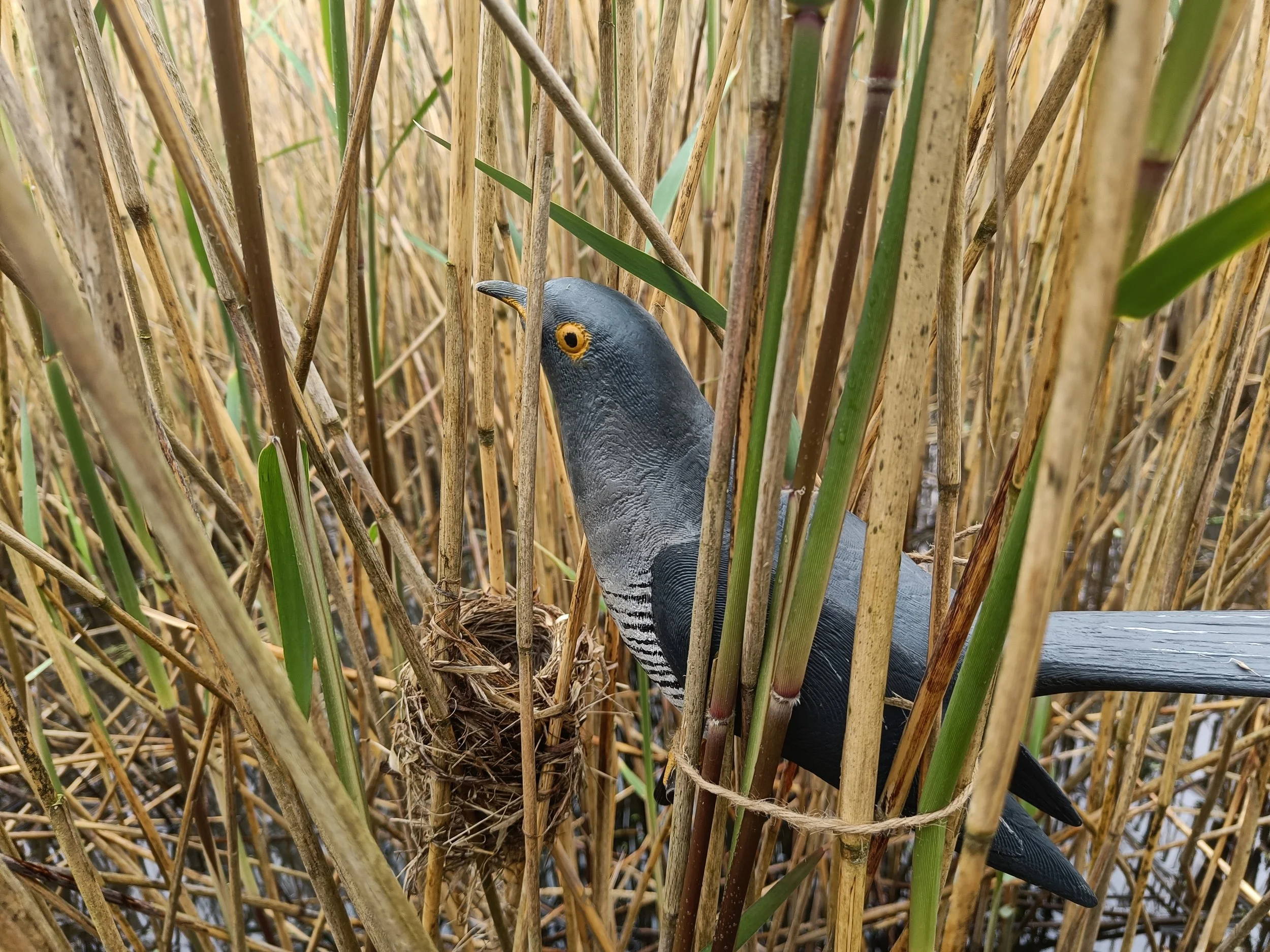
3D printed cuckoo model on a reed warbler’s nest. Photograph: Deryk Tolman.
First, using data collected in 2019-2020, Deryk and his colleagues assessed mobbing and egg rejection efforts after showing the cuckoo’s 3D model near the focal pairs’ nests. Then, to account for plasticity, the warblers were given social information about the cuckoo’s presence: using an old nest from a previous year, the 3D printed model and playbacks of a reed warbler’s mobbing calls. The idea was that hearing other warblers mobbing a cuckoo would give enough information to the focal pair about the presence of the potential parasite, which would then increase their attention and defence efforts. The hosts were then tested a third time shortly after: while they were expected to drastically increase their mobbing and egg rejection displays, most reed warblers in this population seemed to not respond to social information: somehow, they are losing their defence mechanisms.
After this first result a question arose: is it possible that this low response was due to this population’s lack of experience with cuckoos? The idea was to further increase the parasitism risk and opportunities for learning from different neighbors. To test this, during the summer of 2021, Deryk and his collaborators used playbacks of mobbing calls from three different speakers to mimic social information about the cuckoo’s presence coming from several neighbors. Once again, expectation was that, by having information about the presence of a cuckoo, and that has also been confirmed by different neighbors, should increase the defence responses of the focal pairs. Once again, the results were repeated: those who responded without social information increased their mobbing intensity once given social information, while those who did not respond, continued to not respond.
With cuckoos having developed features that mimic those of a hawk, is it possible that the low response is instead caused by the Finnish warblers being especially cautious when defending their nests? To reply to this final question, Deryk collected data during the years of 2023 to 2025, changing the appearance of the cuckoo models and removing the hawk features, while retaining their cuckoo shape: a new non-mimetic cuckoo was born, with simple grey chest and red eyes. This new non-threatening model was presented to the nests with the expectation again to see the reed warblers increasing their mobbing displays, but, once again, the responses remained the same: those who did not mob the normal cuckoo model, continued to not respond, and egg rejection remained rare.
The “geographic mosaic theory of coevolution” is a framework to understand how geographic variation drives the evolution between two species. Since this interaction varies with the area where the species are coevolving, different environmental pressure ensure different outcomes. In areas defined as “cold spots” (i.e. where the interactions are weak or absent), the coevolved adaptation should thus decline.
But what happens to behaviours?
Because of their plasticity, behaviours are assumed unlikely to be lost: the core genetic mechanism can be complex and difficult to modify, plus they can be used for different tasks (for example, the same skill used to recognize an intruder egg could be also applied to recognize edible food from non-edible). Moreover, while they are not being used, selection cannot act on them, and their disappearance should then happen slowly. These results are therefore surprising – but also suggest some underlying costs to plasticity and maintenance of mechanisms that still remain widely unknown. The next step is then to understand why this has happened: why were the defence and recognition skill lost?
Are you interested in learning more about host defence mechanisms against cuckoos? Read Deryk Tolman’s PhD thesis “The behavioural ecology of coevolutionary mosaics: Causes and consequences of geographic variation in host defences against cuckoos”.