ABAURREA, Teresa M. et al. Cuckoos do not select redstart hosts of better quality despite potential growth consequences for nestlings. Animal Behaviour, 2025
Parents provide care to increase their offspring’s chances of survival. The quality of the care depends on the quality of the parents themselves: parents in improved condition provide better care and therefore enhance the chances of their offspring’s survival. Brood parasites, like the common cuckoo (Cuculus canorus), lay their egg in someone else’s nest to avoid the cost of providing care. While brood parasites do not directly take care of their chicks, deciding which nest to lay their egg into is fundamental, since it will determine the quality of care their chicks will receive.
Although oviposition decision has extensively been investigated, there is mixed evidence supporting whether parasites adjust their decision based on host characteristics, and the majority of these studies only focus on the parasitized nest, not taking into account the surrounding host availability and consequences of these choices. What Teresa Abaurrea and her colleagues wondered is: do brood parasites select high quality hosts to optimize their chicks’ growth? Does host availability influence their decisions? And is the growth of parasitic nestlings affected by the quality of the hosts caring for them? To answer these questions, they decided to study the common cuckoo and their most parasitized host in Finland, the common redstart (Phoenicurus phoenicurus). Their aim is to understand if female cuckoos target specific hosts according to parental quality, considering both the availability surrounding the parasitized nest and the consequences of a specific choice. Since better quality pairs usually lay more eggs, researchers used clutch size as proxy for quality.
First, to test whether female cuckoos select high quality redstart individuals (i.e. with larger clutch sizes) to parasitize, the researchers collected data from 2013 to 2022 from ~350 nestboxes scattered in the forests near Oulu, in northern Finland. Abaurrea and her colleagues gathered data on whether a nest was occupied by redstarts, clutch size, and whether the nest was parasitised or not. Additionally, to account for variation in surrounding host availability and quality, they created a theoretical breeding area (i.e. 800m radius areas) around each nest to count how many nests were active at the same time and their clutch size.
Then, to understand if cuckoo mothers choose hosts that will enhance their chick’s growth, from 2014 to 2019 they conducted a cross-fostering experiment, where cuckoo eggs were moved from their original nest to a different one, and therefore creating three treatments: 1) the cuckoo egg was left to hatch in the nest chosen by the mother; 2) the cuckoo egg was moved from the original to another parasitized nest and 3) the cuckoo egg was moved from the original to another non-parasitized nest. After hatching, cuckoo chicks’ weight, tarsus and wing length were measured every 3 days until they were 18 days old.
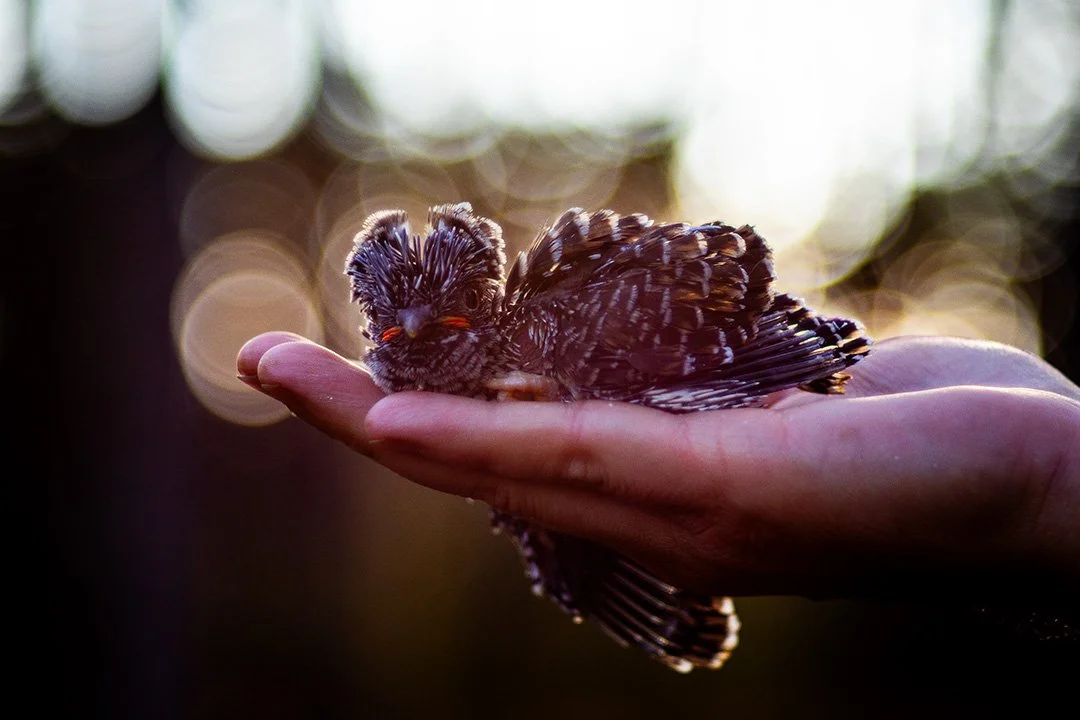
Cuckoo chick. Photograph: Deryk Tolman.
While probability of being parasitized decreases with more nests available in the area, clutch size does not influence cuckoo choice. Moreover, cuckoo chicks’ growth is not influenced by nest choice: chicks from all three cross-fostering treatments grew similarly. However, when doing an exploratory analysis that checked nestling growth depending on the difference in clutch size between the original nest and the one they were moved into, researchers found that nestlings that were moved to nests with the same clutch size as the original one, grew more but slower than chicks that were moved to a nest with a different clutch size from their original nest.
This paper highlights that although there are benefits in selecting specific hosts (i.e. the chicks grow slightly better in the nests that their mothers chose), searching and selecting the “perfect host” might not be worth the effort. When deciding which nest to parasitize, common cuckoos need to take into accounts a multitude of factors, and finding the best quality host while also considering other requirements (e.g. availability, breeding stage, detectability, etc.) might not be worth the benefits the chicks will gain.
Whether individual quality and host availability influence cuckoo’s choices still remains unsolved and is likely to require more sophisticated tools to track cuckoo activity and assessment of host quality.
Are you interested in cuckoo host choice decisions? Stay tuned for the follow-up paper (just submitted!) by Abaurrea et al.: an improved methodology allows to find effects that could not be found before! “Neighbourhood models reveal Common cuckoo parasitism decisions depend on social information”