COEVOLUTION & INFORMATION USE
How do individuals use information to assess risk? What are the consequences for coevolving species in rapidly changing environments?
How do hosts adjust their defences with information, and how does this influence selection in turn?
The Geographic Mosaic Theory of Coevolution is a potentially powerful framework to consider how rapid environmental changes and shifts in species’ ranges affect the ecology and evolution of behavioural defences (and offences). It predicts that there will be hot and cold spots of selection - and the rate at which defences can be attained, upregulated, or lost will determine how coevolution proceeds. However, testing the theory usually requires complex translocation experiments under highly controlled conditions - challenging to do with wild birds!
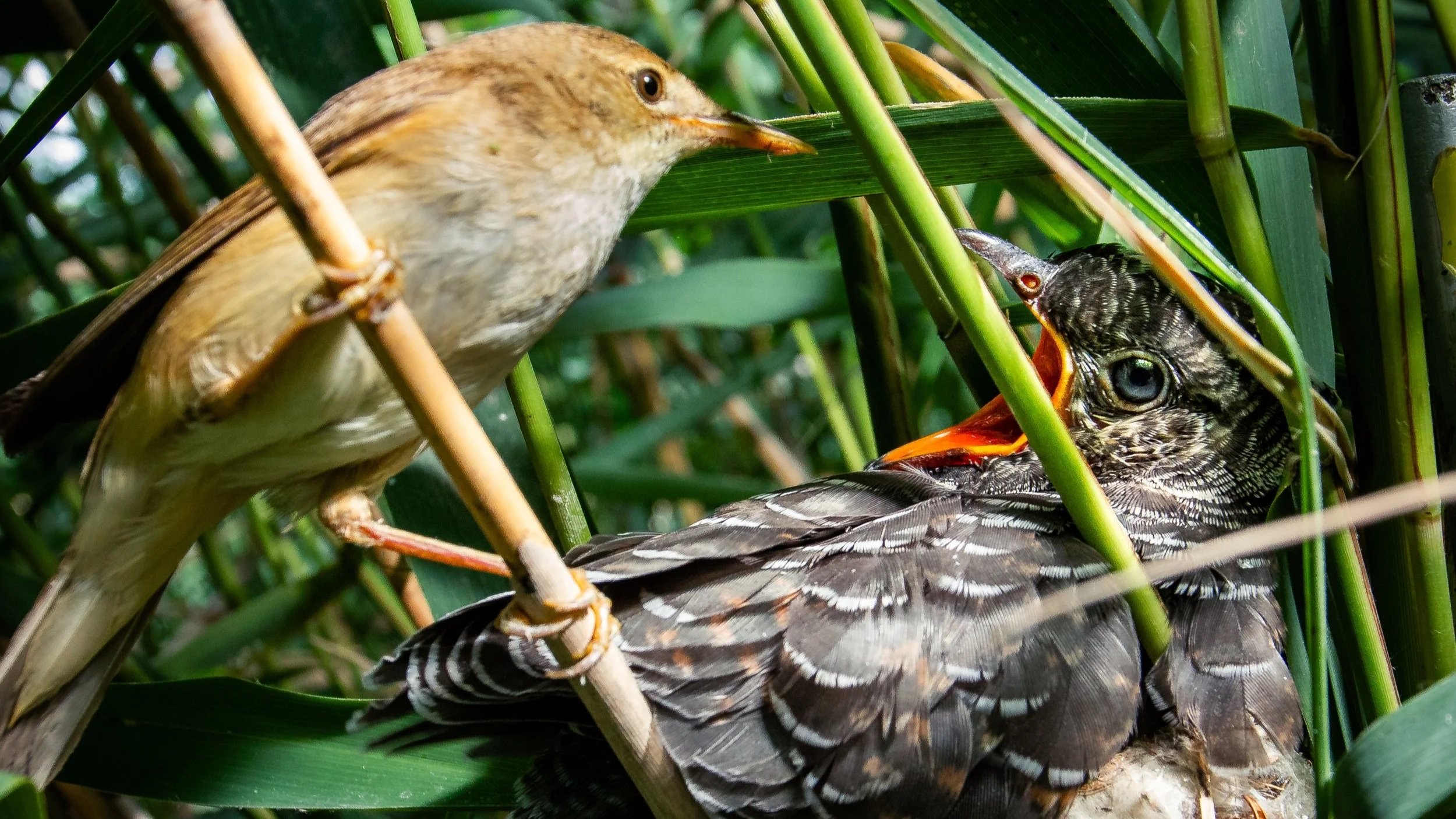
Instead of moving birds, we use field experiments to manipulate information and the perception of local risk. Cuckoos and their hosts were suggested 20 years ago as a key example for GMTC. We know that there is variation across time and space in the ways that hosts defend themselves from parasitism. From our work with Common Reed Warblers across Europe, we know that there is variation across time and space in the expression of defences, and that individuals can fine-tune their behaviour using personal and social information (see here and here). Social information use also has consequences for cuckoos, shifting selection towards rarer forms when their hawk-disguise fails (see here).
But what happens when hosts and cuckoos become allopatric? For GMTC to hold, behavioural traits should wane over time when hosts are not exposed to selection pressures.
We are now focussing on a well-documented range expansion of reed warblers into Finland, currently avoiding parasitism, to investigate whether social information use and plasticity in defences changes as hosts escape, and what might happen should cuckoos reinvade. Incorporating population genomics is also helping us to estimate individual origins and gene flow according to parasitism pressures, and so better interpret our results across space and time.
Example publications:

Large-scale temporal and spatial variation in host defences is explained by hosts' responses to small-scale variation in parasitism risk, not genetic change. Image by Rose Thorogood.

As hosts use social information to assess parasitism risk, cuckoos are under selection to avoid alerting neighbours. Different colour forms is an effective trick. Click for image details
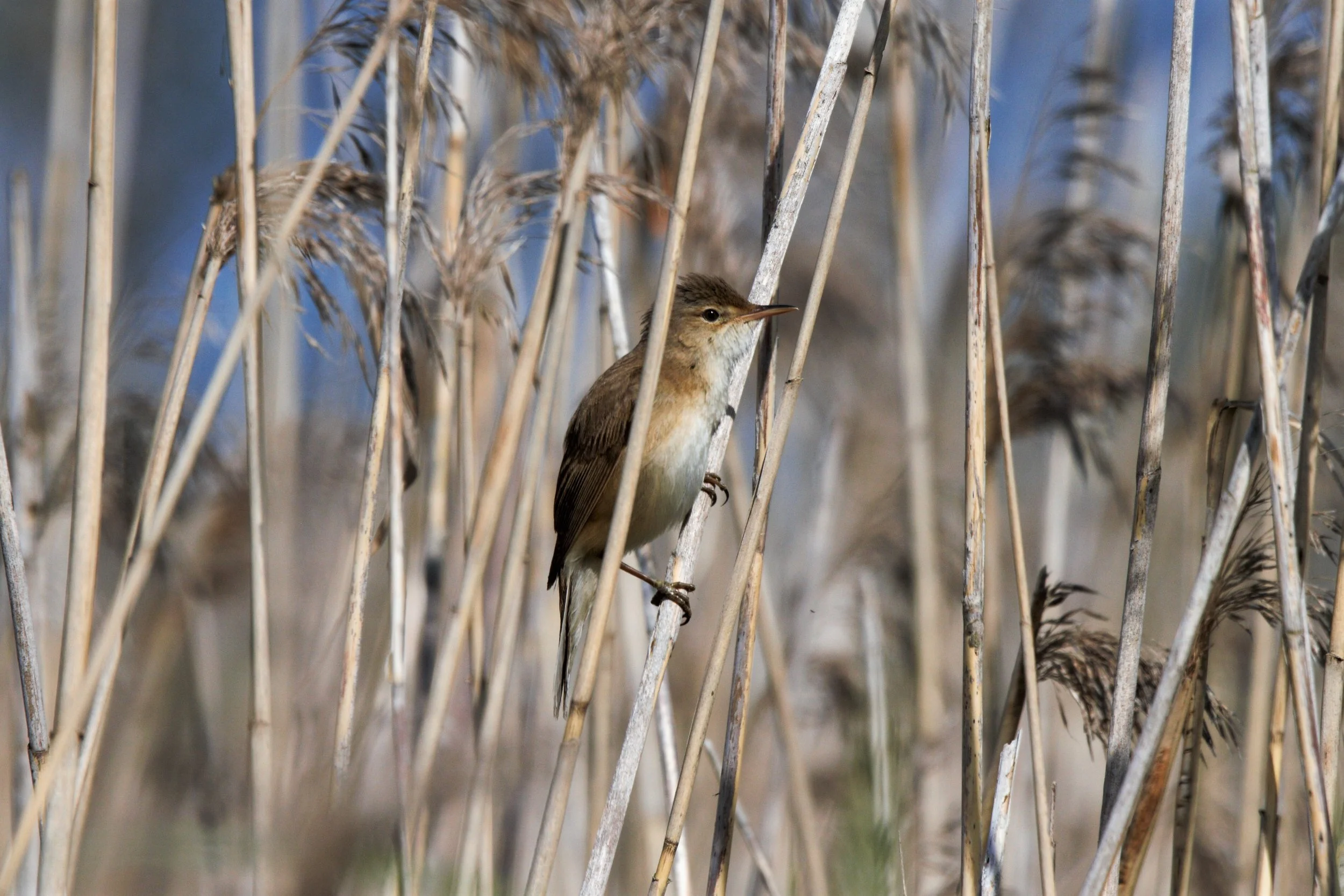
A reed warbler at its range edge in Finland, escaping brood parasitism (at least for now!) - photo: Edward Kluen 2019
Social learning can inform predators when selecting prey

We test effects of information use using great tits as model predators in a Novel World. Image by Rose Thorogood
Social learning is a well-demonstrated method by which animals acquire knowledge about where they should forage, and what they should eat. Much of this work has focussed on learning about tasty food, or receiving positive rewards - but predators may also learn what food to avoid by observing others. If many predators observe the disgust responses of one naive predator tasting a novel prey item, then fewer prey will die.
We have used a mix of experiments in the wild, and experiments with birds in captivity to address whether social information is used by predators to learn about novel warning signals, and how this influences selection and rates of evolution.
This work started with funding from a NERC (Natural Environment Research Council UK) fellowship to Rose Thorogood and an Academy of Finland Centre of Excellence grant in Biological Interactions (Johanna Mappes). It continues in collaboration with Liisa Hämäläinen (previously a PhD researcher in the group with funding from Finnish Cultural Foundation, now a Research Council of Finland research fellow at the University of Jyväskylä, Finland).
Example publications:
Hämäläinen L, Mappes J, Rowland HM, Thorogood R. (2019) Social information use about novel aposematic prey is not influenced by a predator's previous experience with toxins. Functional Ecology, 33, 1982-1992. DOI: 10.1111/1365-2435.13395
Thorogood R, Kokko H, Mappes J. (2018) Social transmission of avoidance among predators facilitates the spread of novel prey. Nature Ecology & Evolution, 2, 254. DOI: 10.1038/s41559-017-0418-x
Hämäläinen L, Rowland HM, Mappes J, Thorogood R. (2017) Can video playback provide social information for foraging blue tits?. PeerJ, 5, e3062.