COEVOLUTION & SPECIES INTERACTIONS
How do individuals use information to assess risk? What are the consequences for coevolving species?
How do hosts adjust their defences with information, and how does this influence selection on cuckoos in turn?
We know that there is variation across time and space in the ways that hosts defend themselves from parasitism. We also now know that this is usually because of behavioural plasticity, rather than rapid genetic changes among populations. There are costs to removing cuckoo eggs, or mobbing adult cuckoos; so how do hosts best match their defences to risk?
Our work with reed warblers and Common cuckoos in the UK showed that hosts use both personal and social information to fine-tune their behaviour (see here and here), and the way they use social information has consequences for cuckoos. As reed warblers pay attention to the specifics of the information provided when neighbours mob cuckoos, rare colour forms have an advantage (see here).
But what happens when hosts and cuckoos become allopatric? Geographic mosaic theory of coevolution predicts that there will be hot and cold spots of selection - and the rate at which defences can be attained, upregulated, or lost will determine how coevolution proceeds. We are now focussing on the range expansion of reed warblers into Finland to investigate whether social information use and plasticity in defences changes as hosts escape, and what might happen should cuckoos reinvade.
How about cuckoos? Females specialise on different host species, producing extraordinary diversity in mimetic egg colours. But how do cuckoos tune their offspring to match the host’s chick-rearing environment? This is being studied in a nest-box using population of redstarts in Oulu, northern Finland by PhD student Teresa Abaurrea.
Team: Deryk Tolman, Katja Rönkä, Edward Kluen, Teresa Abaurrea (University of Helsinki, Finland), Bård Stokke, Frode Føssøy & Brett Sandercock (NINA & NTNU, Norway), Robert Thomson (UCT, South Africa), Fabrice Eroukmanhoff (Oslo, Norway), Daniela Campobello (Università di Palermo, Italy), Kristal Cain (University of Auckland)

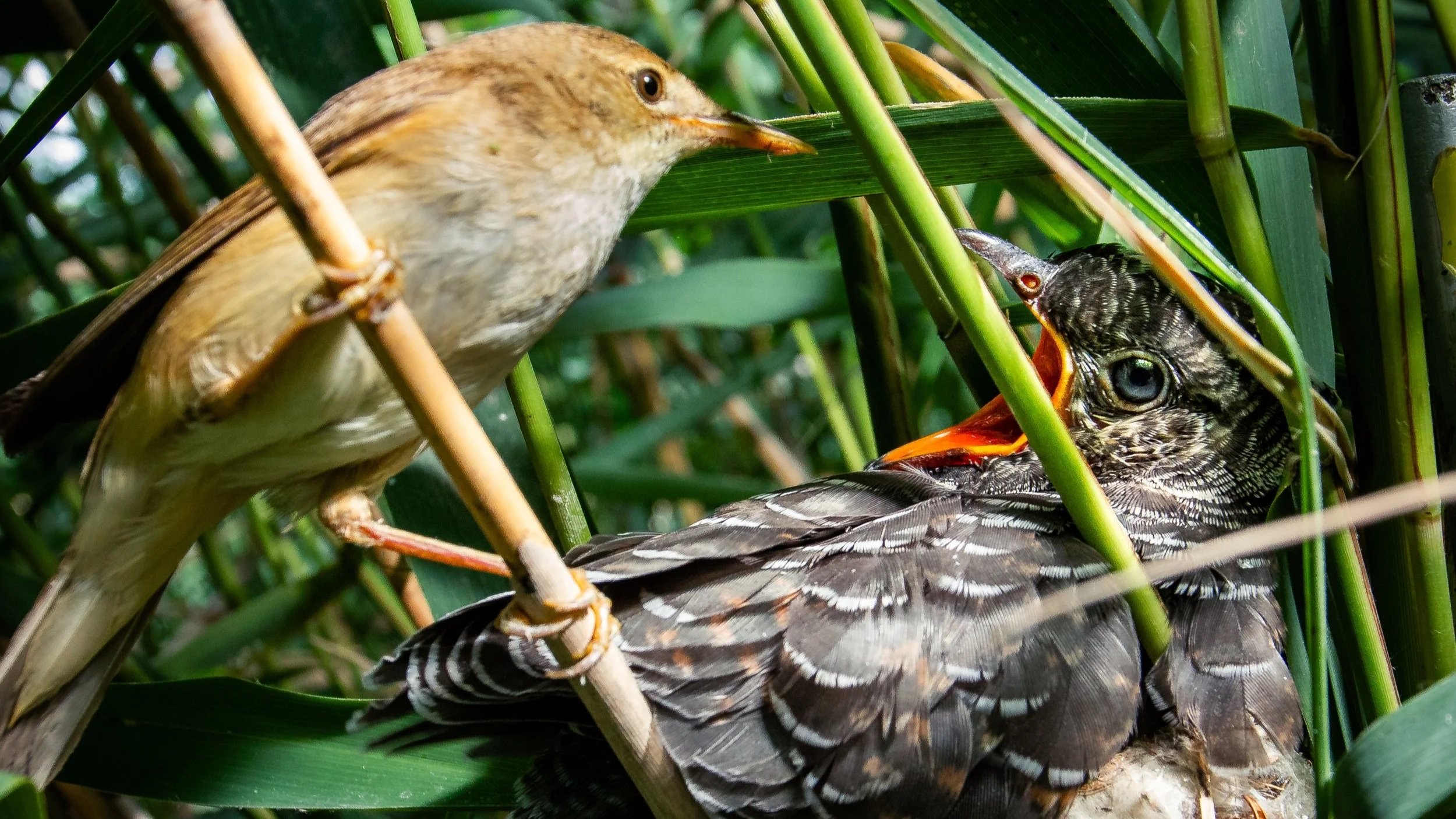
Large-scale temporal and spatial variation in host defences is explained by hosts' responses to small-scale variation in parasitism risk, not genetic change. Image by Rose Thorogood.

As hosts use social information to assess parasitism risk, cuckoos are under selection to avoid alerting neighbours. Different colour forms is an effective trick. Click for image details

Social learning can inform predators when selecting prey

We test effects of information use using great tits as model predators in a Novel World. Image by Rose Thorogood
Social learning is a well-demonstrated method by which animals acquire knowledge about where they should forage, and what they should eat. Much of this work has focussed on learning about tasty food, or receiving positive rewards - but predators may also learn what food to avoid by observing others. If many predators observe the disgust responses of one naive predator tasting a novel prey item, then fewer prey will die.
We are using a mix of experiments in the wild, and experiments with birds in captivity to address whether social information is used by predators to learn about novel warning signals, and how this influences selection and rates of evolution.
Team: Liisa Hämäläinen (University of Macquarie, Sydney, Australia), Johanna Mappes (University of Jyväskylä, Finland), Hannah Rowland (Max Planck Institute for Chemical Ecology, Germany)
Mainly funded by a NERC (Natural Environment Research Council UK) fellowship to Rose Thorogood, PhD funding from Finnish Cultural Foundation to Liisa Hämäläinen, and an Academy of Finland grant to the Centre of Excellence in Biological Interactions (Johanna Mappes).
Key publications:
Hämäläinen L, Mappes J, Rowland HM, Thorogood R. (2019) Social information use about novel aposematic prey is not influenced by a predator's previous experience with toxins. Functional Ecology, 33, 1982-1992. DOI: 10.1111/1365-2435.13395
Thorogood R, Kokko H, Mappes J. (2018) Social transmission of avoidance among predators facilitates the spread of novel prey. Nature Ecology & Evolution, 2, 254. DOI: 10.1038/s41559-017-0418-x
Hämäläinen L, Rowland HM, Mappes J, Thorogood R. (2017) Can video playback provide social information for foraging blue tits?. PeerJ, 5, e3062.
Funding: