
Can video playback provide social information for foraging blue tits? Yes, but do they use it?
Liisa's first PhD paper is out! Read her blog post to help us solve why the results are still puzzling.
Two weeks ago marked a big moment for the Informed Birds research group - my first PhD paper (and Rose’s first paper as a PhD supervisor!) was published:
‘Can video playback provide social information for foraging blue tits?’
L. Hämäläinen, H.M. Rowland, J. Mappes, R. Thorogood. PeerJ 5, e3062 (2017).
I conducted this experiment last winter at the Sub-Department of Animal Behaviour in Cambridge using 25 blue tits from Madingley Woods (all birds were returned to the woods after 4 days). My aim was to investigate how blue tits use social information about food palatability, and I studied this using video playback of a foraging demonstrator.
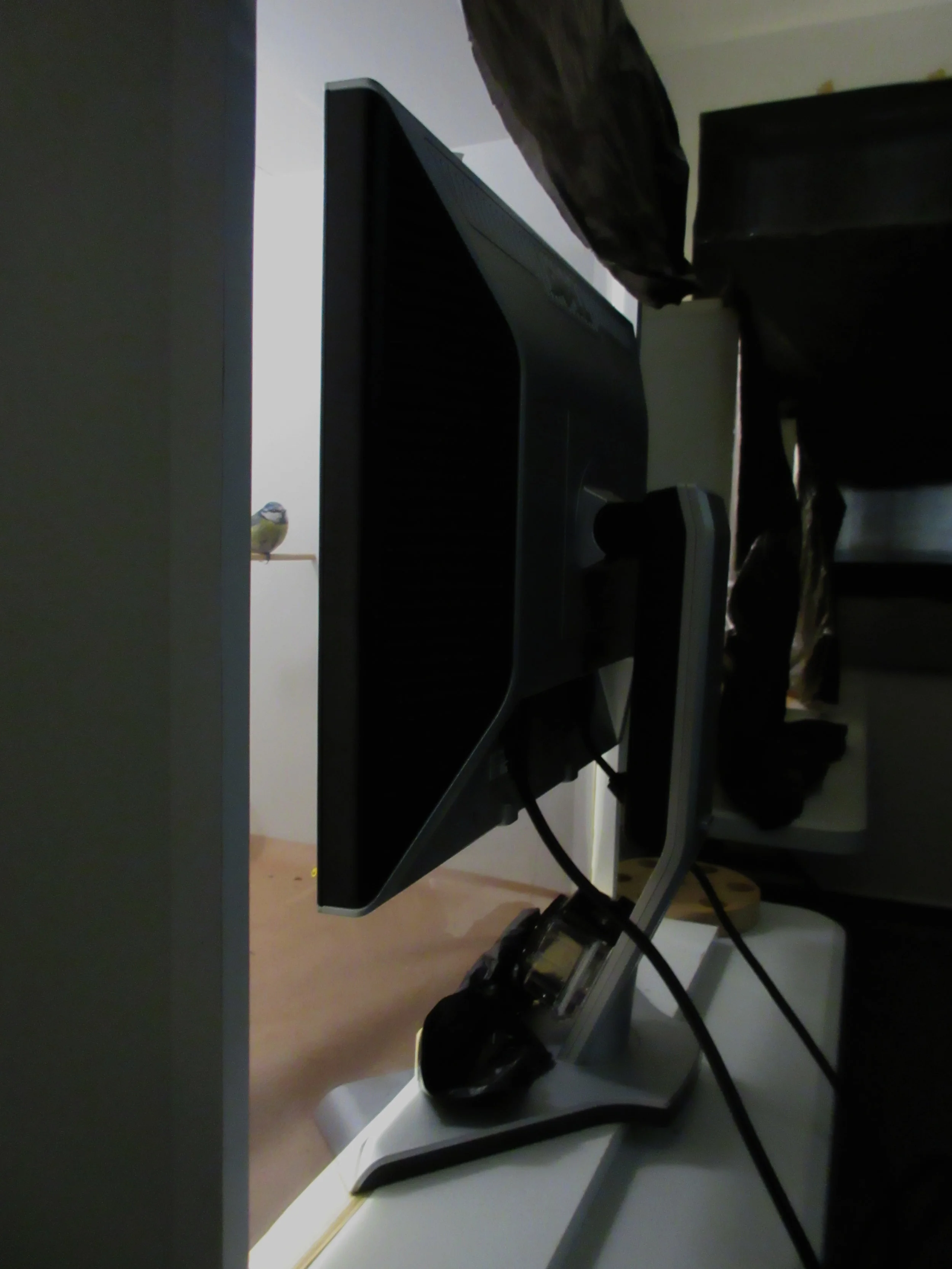
A blue tit (Cyanistes caeruleus) watching video playback (L. Hämäläinen)
Video playback should be a good tool for studying information use – all birds can receive a “standard” amount of information – but video playback had not been used with blue tits before. Therefore, we first tested if blue tits would pay attention to birds on a screen.
We found that blue tits clearly paid attention to the demonstrator bird: they hopped on their perch more when a bird was on the screen versus when there was only a feeding cup. We also found that birds behaved differently, depending on what the demonstrator was eating – observers paid more attention if the demonstrator ate a bitter-tasting mealworm! We don’t know if this was because the demonstrator was more active when eating a bitter prey item (like many birds, blue tits wipe their beaks and shake their heads vigorously), or because this aversive response provided more “useful” information for observers.
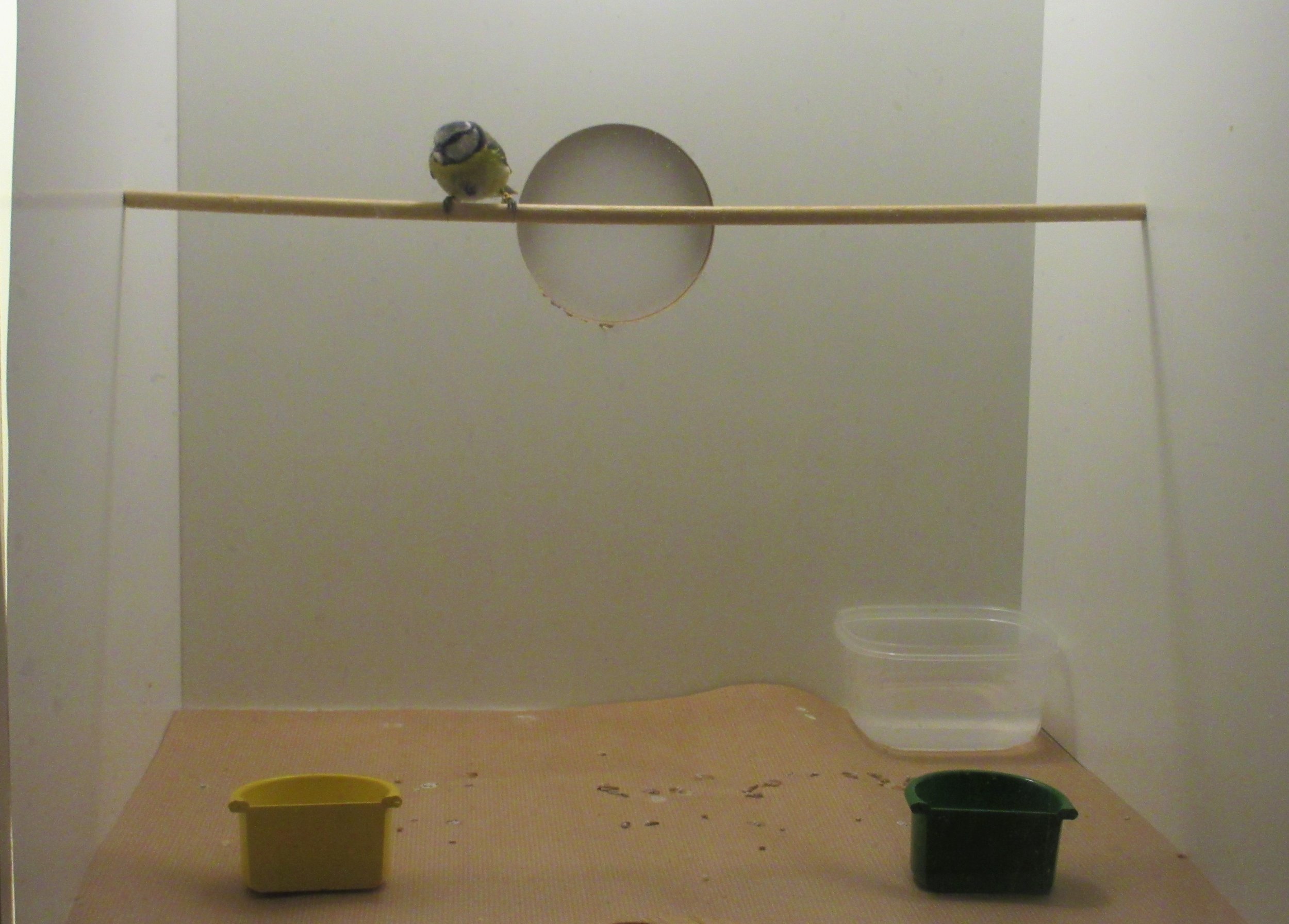
Hm, which cup? Social information about cup colour and potential food items did not lead to copying, but birds did make decisions faster. (L. Hämäläinen)
The second part of my experiment tested if a demonstrator’s behaviour affected the observer’s food choices. The idea was that blue tits that observe another find and eat a bitter worm should avoid foraging from the same coloured cup – in other words, observers should associate cupc colour with the risk of finding unpalatable prey. On the other hand, watching a demonstrator find a palatable worm should result in observers foraging from the same coloured cup.
Contrary to our prediction, we found that the observers did not seem to use social information in their foraging decisions. Instead, from a choice of two cups 50% of birds chose the same cup as the demonstrator (regardless of its contents). This suggested that the blue tits’ foraging choices were completely random, but we decided to look at the results more closely to try and understand why.
In fact, watching a demonstrator did affect their foraging! Birds that matched our predictions (i.e. avoided the cup after a demonstrator found an unpalatable worm, or chose the same cup after witnessing a demonstrator find a palatable worm) made their cup-choice much more quickly than individuals who did not. This suggests that birds that appeared to choose at random may actually have been influenced by social information – but we’re not (yet) able to explain how this happened. Any ideas?
In summary, our results suggest that video playback can provide social cues to blue tits and it therefore provides a promising method for studying social learning in parid tits. However, we still do not know how these cues are later used in decision-making and this will be the challenge for the next chapters of my PhD!
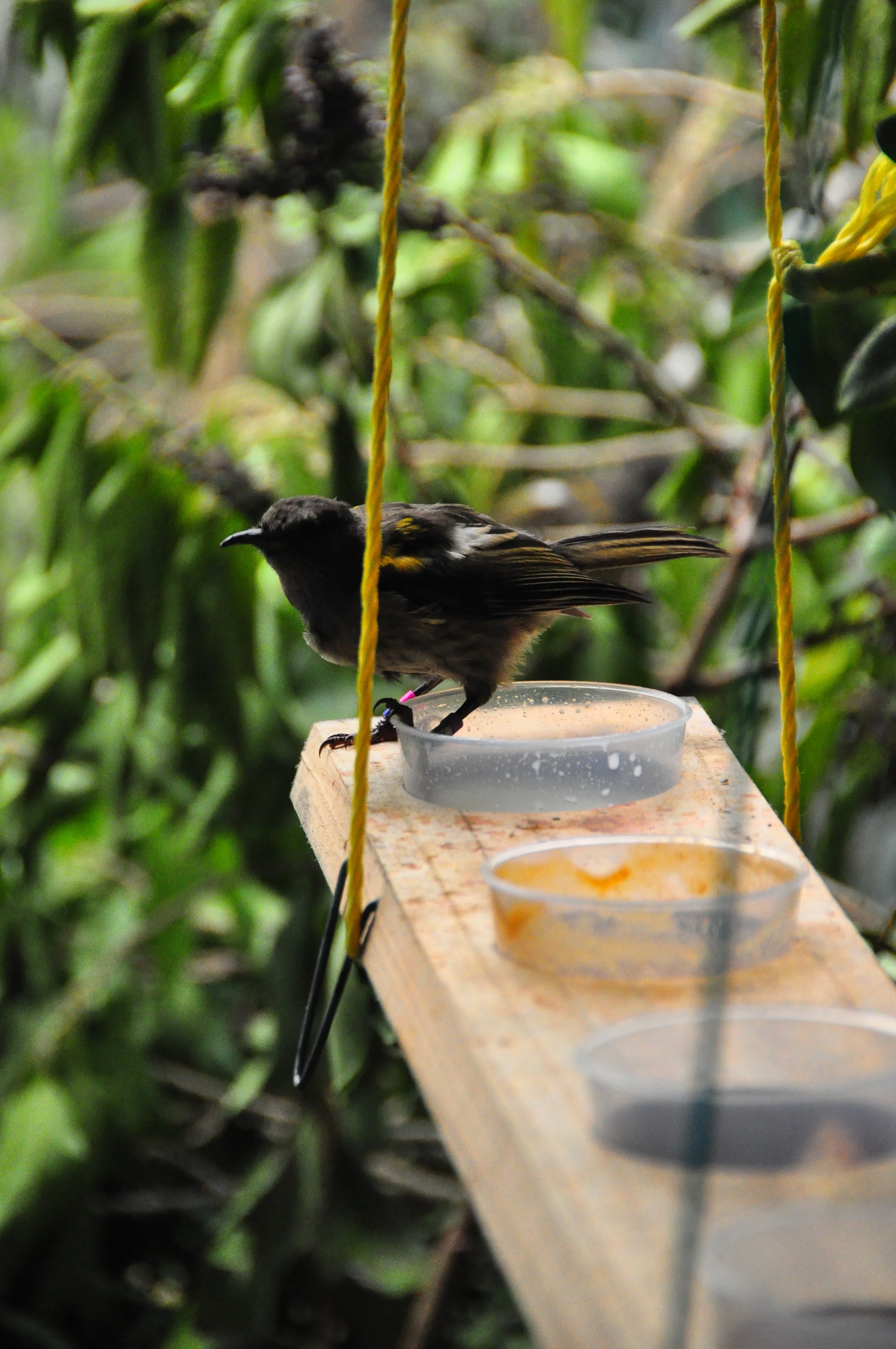
Hihi translocation in progress
Translocations are an exciting time for hihi conservation - we're starting a new population, and also learning how the birds' social environment influences success.
In 2005, we reached a milestone with hihi on Tiritiri Matangi Island with the first translocation of birds to seed a new population (Zealandia, in Wellington). Thirteen years (and many translocations) later, Vix and Caitlin are now experiencing their first hihi translocation.
The translocation in 2005 was also an experiment: the hihi recovery group tried something new - most of the birds moved were juveniles. Tiri was producing lots of young each year, but it was suspected that there were not many opportunities for them to recruit to the breeding population.
Since the first Tiri translocation, we've been looking more closely at juvenile behaviour. First, Kate Richardson's research with hihi moved to Maungatautari suggested that dispersal and choice of breeding location might be influenced by broad-scale familiarity among birds. Now, Vix's PhD research is showing us that juvenile hihi spend lots of time together, and some individuals have stronger social bonds than others. How will translocation alter these bonds? Will moving "friends" together make it easier for them to adapt to their new location after translocation? How will they respond to the changes in resources? And, what happens to the birds left behind on Tiritiri? This translocation to Rotokare - the first to investigate the role of social behaviour in this context - should give us some answers. But, given what we know about hihi already, it's sure to also throw up lots of surprises! Stay tuned...
How to prep an aviary for #hihitranslocation. Should start catching birds in morning! @docgovtnz @ZSLScience @DOCTSAmbassador pic.twitter.com/fWq4Uyssvo
— Dr John Ewen (@hihinews) 26 March 2017
Happy hihi settling and tucking in to their "cafeterias" on the #hihitranslocation. They're spoiled for choice! @hihinews @informedbirds pic.twitter.com/IYcKG1ncj9
— Vix Franks (@VixFranks) 28 March 2017
Liisa Hämäläinen begins her 1st field season
Liisa is now spending her time out in Madingley Woods, collecting data to compile a social network for the blue and great tits. Her first experiments will combine captive experiments with specific birds that she'll be removing (temporarily!) from the woods. It will be a busy few months, good luck Liisa!
Good luck for the field season on #Tiritirimatangi @VixFranks
Victoria is on her way to New Zealand for her second field season. She'll be based at Tiritiri Matangi Island until April 2016, and manipulating the ways that juveniles learn about their environment. If you're visiting New Zealand, make sure you include a trip to Tiritiri to visit Vix and our hihi!
Congratulations @VixFranks on a job well done!
Vix is now officially a PhD student after flying through her 1st year viva today.