
Two papers in one week: how birds learn (and why it matters!)
Highlights! A quick summary of our two papers out this week on associative learning by hihi, and the coevolutionary consequences of social transmission among predators.
Week 51 turned out to be a big week for our group: two papers out to finish the year!
The first paper from Victoria Franks' PhD was accepted by Behavioural Processes: "Older and wiser? Age differences in foraging and learning by an endangered passerine." This was the culmination of hard work in the field and behind a computer, to understand what and how hihi juveniles learn. The study forms an important part of Vix's thesis because it reminds us that adults and juveniles do not necessarily learn about food in the same way - and it dispels any rumours that hihi can't learn!

A male hihi learns to associate the while circle with a food reward. From Franks & Thorogood Behavioural Processes 2017.
Secondly, we had a big paper come out from our work on the co-evolutionary consequences of social interactions among predators in Nature Ecology & Evolution: "Social transmission of avoidance among predators facilitates the spread of novel prey". This was the experiment that started our core research project, but it needed some nice modelling by Hanna Kokko to finish it off. There's more in a "Behind the Paper" blog post on Nature Ecology & Evolution Community, and Science News produced a fantastic video about it:
Finally, Liisa Hamalainen and her assistant Marianne Teichmann have now finished a gruelling set of experiments in Konnevesi continuing this research project. The take home message: Blue tits never do what you expect them to!

Unravelling the mystery of Shining (bronze) cuckoos' dark green eggs
New paper out at Auk - and why it took six years to publish!
This week we've had a paper published in Auk which marks a personal triumph!
In 2010, I travelled to Kaikoura, New Zealand, to do some pilot work as a Phyllis & Eileen Gibbs' Travelling Research Fellow (a one-year fellowship from Newnham College, Cambridge). With the support of Rebecca Kilner (U. Cambridge U.K.) and Jim Briskie (U. Canterbury NZ), I investigated whether the study population of Grey warblers (a.k.a. Grey gerygones) and Shining cuckoos (Chalcites lucidus a.k.a. Chrysococcyx lucidus... phew!) could help us to unravel why Shining cuckoo eggs are dark olive-green and to learn more about their chicks.
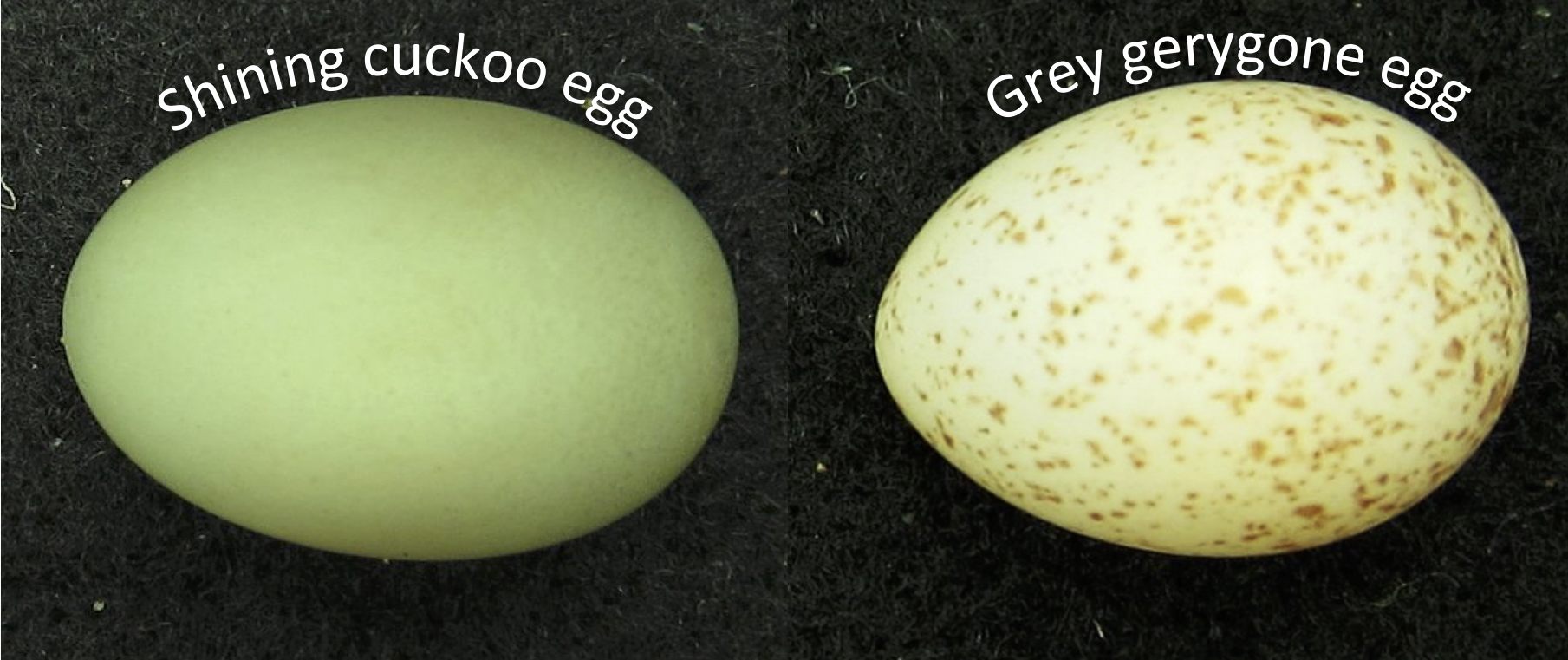
Most species of cuckoos in the Chalcites genus lay dark green eggs, while their hosts lay eggs that appear very different. Back in the 1980s, Marchant and the Brookers suggested that this might be to help hosts detect cuckoo eggs, or perhaps, to avoid other cuckoos from removing their eggs preferentially. It wasn't until 2009 however, before Naomi Langmore and colleagues produced a nice comparative study using animal vision models which started to investigate these hypotheses.
With the help of Justin Rasmussen, who was conducting experiments for his PhD on the cuckoos, I decided to test this hypothesis with an experiment: if cuckoo eggs are visible for hosts, do they show rejection behaviour? Justin and I added a clay egg that was a similar hue to Shining cuckoo eggs (according to calculations from an avian vision model) to as many Grey warbler nests as possible. However, these varied in brightness - same as cuckoo eggs, twice as bright, or white (the maximum brightness possible). Despite being highly visible, none of our hosts showed any sign of rejecting the eggs, and instead incubated them along with their own eggs.
Much to our surprise, however, four of the nests were parasitised naturally by cuckoos after we'd acted as cuckoos ourselves. And, at three of these nests, our "cuckoo eggs" were taken instead of a host egg!

A Grey warbler (Gerygone igata, Grey gerygone) nest after predation - see the hole in the roof.
Frustratingly, many of our host nests were eaten before or during our experiments - one peril of trying to conduct experiments with New Zealand birds at unprotected sites on the mainland! New Zealand birds just aren't adapted to coping with the hunting strategies of rats, stoats, weasels, possums, and cats that have been introduced (intentionally or otherwise) by humans. Despite our best efforts, this kept our sample sizes smaller than we would have liked.
Luckily for us, four years later Ros Gloag, Naomi Langmore and others conducted a similar experiment with the closely related Little bronze cuckoo and its Gerygone host in Cairns, Australia. With a great sample size, they showed that cuckoos do indeed appear to remove foreign eggs preferentially over host eggs, and at far greater rates than hosts. The publication of this paper gave our results greater weight, because the two studies produced similar results.
So, six years later almost to the day, our efforts have finally paid off! I also learned a valuable lesson - without pest control or physical protection, we are unlikely to learn much more about cuckoos and gerygones in New Zealand. Grey warblers inhabit scrubby edge habitats. Unfortunately, Grey warbler habitats are rarely the types of forest chosen to be protected in conservation projects. The future might lie in finding as many nests as possible across the country. This will only be possible with citizen science projects like this one started by Michael Anderson (Massey University NZ).

Informed birds visiting Antzz in Helsinki
Although our work focusses mainly on birds, and the consequences of their information use for others, some of the best examples of how social behaviour evolves are to be found in invertebrates. From August, I'll be a long-term visitor to the ANTZZ team at the University of Helsinki, led by Prof. Liselotte Sundström. Lotta is one of the directors of the Centre of Excellence for Biological Interactions (our collaborator Prof Johanna Mappes, in Jyväskylä, is another), and being here offers a really exciting opportunity to learn more about social evolution from the view point of Formica ants. Vix and Liisa will be visiting regularly from Cambridge, and I'll be visiting them often too.
See here for more about Team ANTZZ
Science Cafe kicks off 2016 Cambridge Science Festival
Kirsty and Rose are running the Science Cafe event again as part of this year's Science Festival. Despite pretty awful weather conditions on Saturday March 5th (gales, rain, and hail!) we reached over 70 people during the 3-hr event in the Cambridge Market Square. Our goal is to communicate how exciting science is to an audience who perhaps wouldn't normally come to the Science Festival - fingers crossed for better weather next weekend!